Friday, October 26, 2012

Dasara/Navratri

Dasara/Navratri ended a few days ago.  It's a ten day festival and one of the most important Indian holidays.  It represents the day and time period when the patron Goddess of Mysore, Chamundeshwari/Durga, killed the demon Mahishasura.  This year was the 402nd year that this holiday has been celebrated.  There's a food fair, flower show, magic shows, concerts all over the city, sports events, lights, and exhibition grounds.    


The whole city lights up.  They bring in extra electricity so everyone enjoys ten days of running water and no power cuts.  


Devaraja Street-main street downtown


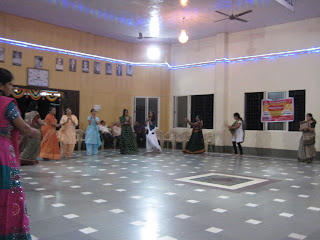
In North India, Dasara is celebrated as Navratri, ten days of daandiya raas and garba, a traditional dance with 'sticks.'  We  managed to find a Gujarati community in Mysore and celebrated with one night of raas/garba.  


Garba--dance around in one big circle

 It's amazing how different North and South India are.  Two of my co-workers had never danced raas garba before (something I grew up with) and were so excited to participate in something they had only seen in Hindi movies.  


The last day of Dasara is celebrated with a parade of elephants and floats from all over the state of Karnataka.  Even within the state there are many, many diverse cultures, traditions, and people. 

 Painted elephants start and end the parade

A series of 25-30 floats: 

Wooden toys 
Depictions of Ayurvedic Medicine
 Drums made out of wheels

 The procession began at Mysore Palace-home to the Wadiyer Dynasty.  
Shruthi, my roommate, and Priti, a volunteer with Indicorps

Mysore Palace


Monday, October 15, 2012

Gandhism

Outdated post no. 2: October 2nd was Gandhi's birthday or "Gandhi Jayanti" which was celebrated at our organization with speeches, singing, clearing weeds and planting trees.  


Speech by University of Mysore Professor on "Gandhism and the evils of globalization of material goods"

Picking rocks or weeds out of the soil

In Mysore, I'm working with a Cornell professor on a maternal/fetal nutrition study.  Here, we are collaborating with the Swami Vivekananda Youth Movement.  This organization was started by Dr. R Balasubramaniam, a truly inspirational person, in the 1980s.  It started as a rural hospital that provided care to tribal and non-tribal populations and has expanded into a Development Leadership Masters program (the students in the picture above), a grassroots research organization (GRAAM), a palliative care program, and more.  I'm working directly with the research organization.


 The creative thinking and sharing of information never ends at this organization (sometimes at the expense of getting work done).  A sociology PhD and host for the night reads us poetry written to her by her husband.  Although I understood maybe 10%, but better than the 0% when I started here! 


Anyway back to Gandhism, a term that has come to mean many things, many things that are often not practiced.  In the context of economics, a true "Gandhi-ist" believes in 'simple living' and 'self-reliance'.  While India was able to break free from the British Empire and maintain some degree of self-sufficiency, I wonder if even Gandhi could have taken on the next big invaders: Walmart and Starbucks. 

A few weeks after I got to India, the Prime Minister, Manmohan Singh, increased foreign direct investment (FDI) to 51% in multi-brand retail and 100% in single-brand retail.  This means that when Walmarts start opening (already one wholesale store), the company will own 51% of the store and profits while for stores like Starbucks or IKEA, the company will own 100% of the store/profits.  

The government has high hopes for FDI. The commerce minister quoted that companies like Walmart will be integral in the “creation of an infrastructure, an integrated food chain, bringing in the newest technology."  The food distribution system in India is inefficient and lots of food from small farms and other producers rots before it gets to consumers.  Walmart will buy directly from farmers, helping farmers while cutting out middlemen and wasted produce.  The reality--Walmart will probably buy from farmers that are already doing well and own large amounts of land.  Either way, the small farmer may turn into the farm-hand/agricultural employee in the not too distant future.  Something needs to be done to make the food system in India more efficient.  I'm not so sure the answer is foreign direct investment (FDI). However,  the answer of non-corrupt, efficient government may never exist in India (or many places in the world).

At any rate, political groups were not too happy with this increase in FDI so the BJP, a party that advocates self-reliance, called for a nationwide "bandh."  Basically, during a bandh, which translates to 'closed', the city shuts down and there is no transportation...no buses, no trains, no cars, and almost no motorcycles (most popular form of transportation).  Even major cities like Bangalore completely shutdown.  Bus drivers who choose to drive are either threatened or end up with slashed tires or vandalized buses.  Not quite the non-violent protest.  

Actually, one of my co-workers asked, "In NYC, do they have protests?  What do people do when they protest?"  

My answer: "They camp out in a park?"  

I just can't  imagine a protest about anything in the US completely shutting down a city, at least not since the Rodney King riots.  

Reflecting on Occupy Wall Street protests this past year, I realize, perhaps we're all protesting the same thing.  It's the 99% protesting against that 1% except in this case the 1% is us, the US, our companies (not just Wall Street).  Should we be protesting with the world and give up shopping at Walmart?  Not likely.  

I've come to learn that "bandhs" are a frequent way of protesting in India.  Next post will be part 2: Karnataka bandh for water security.  

For now, my own protests remain small scale.  This week, I refuse to eat white rice three times a day. 

BTW--for those following up on the Nobel prizes awarded last week-I never realized Gandhi never won the Nobel Peace Prize.  He was nominated 5 times (1937/1938/1939/1947/and finally Jan 1948-only a few days before he was assassinated).  Since the Nobel Peace Prize isn't given posthumously (except one exception), that year the prize was awarded to no one as "there was no suitable living candidate" according to the Committee.  

ALSO--The word Gandhism is probably something Gandhi would have hated.  


Saturday, October 6, 2012

Side/entrance of the Hostel

Path around local lake

Some scenery: 


Main office-Swami Vivekananda Youth Movement


Sunday, September 30, 2012

Inspiration

It's almost a month into my trip and I'm finally writing my first blog post.  I want to say it has taken me so long because I have been busy.  That's somewhat true, putting this project together (which I will discuss at a later point) has involved a lot of reading and learning.  But I haven't been able to write because of a million other reasons I can probably make up (including being a little homesick).

But, it's no longer the case because I found my reservoir.  (For those not in NYC, there's a large reservoir in the middle of Central Park-beautiful spot to run)  I always say that I wouldn't have been able to live in NYC if Central Park didn't exist. After 3 weeks of working and living on the same street in an Industrial Area on the outskirts of Mysore, I discovered a beautiful lake (pictures to come), and I finally felt like I will be okay here for 9 months and can make this somewhat of a temporary new home.

I actually find comfort in the parallels between Mysore in NYC.  For example, instead of being a tourist traveling to the center of Mysore city, equivalent to Penn Station/Times Square area, I avoid the city and instead walk 3 miles every Sunday to an area that's probably the equivalent of the Upper West Side. There's a coffee shop and restaurant where I get North Indian food, study the local language (Kannada), and think/reflect. Enough with NYC, although for those that know me well aren't you glad I'm not talking about Chicago?    

I am currently working with an incredible organization.  It's a grassroots research organization that works with companies, NGOs and the government to evaluate development project and the many government "schemes, or social welfare programs the government starts.  While these schemes mean well and perhaps if they were actually put into place India would have more resources for the poor but schemes=scams?  Not  quite, but a lot of resources are being mismanaged and there is a lot of corruption.  Though, the group I'm working with, GRAAM, is Indian advocacy at its best and in a day individuals will be passionately discussing ways to deal with child labor, health care, and the caste system.  I'm truly lucky to be here.

At the same time I wonder why exactly I am here.  I mean, I know my personal motivations, my year long goals and am excited about the opportunity of being here.  But the bigger question, what role does the West have in a countries like India?  There is a very strong society with pockets of activism that I doubt are even present to the same extent in the US.  There are truly inspirational individuals with innovative, locally brainstormed ideas much better than some of the ideas imported from the West.  True, there are many other things, including complacency and corruption but that's a story for another time.    

TODAY'S STORY (took me long enough to get here): 

On a walk around my new favorite lake, I was talking to my also new roommate (who finished medical school last year in Mysore and is now applying to public health schools in the US) and a community trainer.  To be honest, I have no idea who he was but I just know he works on a lot of social empowerment projects with the HIV/AIDS population in and around Mysore.  He was also discussing the work he does with female sex workers in Bangalore (IT capital of India 2-3 hours away).  One program he described teaches and encourages sex workers to save their money.  If they make 1000 rupees a day ($20), they should try to save at least 100/day.  That way eventually they no longer feel the necessity to work in the trade every day and in the long term can save enough to invest in another business or have a financial security blanket as they try to find other work.  Typically, there is no culture of saving.  These women feel like they are always broke and have to work to make money.  (A lot of money goes to alcohol, which makes the job more tolerable) On the other hand, the women feel like there are no other jobs available to them where they can make 1000 rupees a day.  This might be true, which is why in some ways this program actually works.  My first reaction is to want to find something else for the women to do right away, almost "rescue"them from sex work, if that's what they want. "Rescuing" is probably not the right thing, instead what's needed is more "help others help themselves."  Of course this can go sour, like anything, like when the US interprets this as give weapons to Afghan/Central American/etc. rebels...and maybe sometimes rescuing is needed in extreme situations.

There were many other great programs that this man described.  They evaluate these programs too so for example, an HIV/AIDS education and importance of condom use program has decreased the incidence of HIV/AIDS from 14% down to 8% in the last 4-5 years in the population the group is working with in Bangalore.  All of the programs he mentioned had a staff of about 60 and cost enough money for us to ask him where he got the funding from.  Answer: the Gates Foundation.  And, there was the answer I was looking for to the role of the West. While the ideas, projects, and implementation may be best coming from local groups, it is going to be a long time before donations, grants, "aid" are not needed anymore.  May not be sustainable, but perhaps a cultural change doesn't need to come from a sustainable program.  For example, if enough money and support is poured into a culture of saving and finding other business or job opportunities for sex workers, eventually (ideally) the program can stop but the end results will be sustained with societal change.  Probably not, but I'm still young enough to be idealistic :)

I think my new goal should be to make loads of money, start a foundation, and fund local people with great ideas and the motivation and drive to implement them.

I will try to have more picture-oriented posts in the future when I take more pictures...
The hostel I live in.